
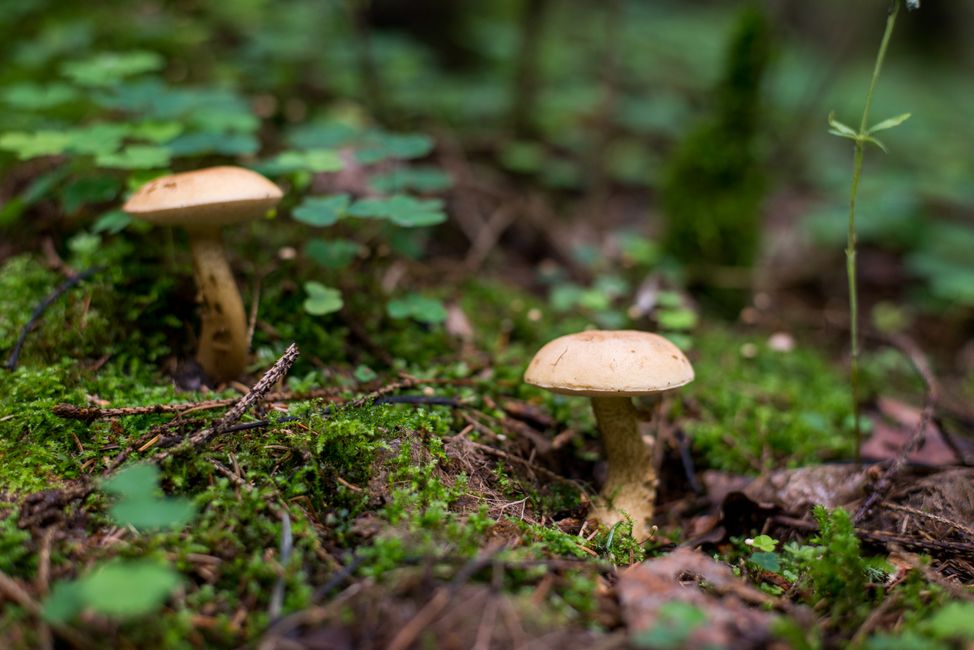
For almost a hundred years, scattered reports from different corners of the world have told the same strange story. People who ate certain wild mushrooms began seeing something extraordinary: dozens, sometimes hundreds, of miniature human figures moving through their everyday surroundings. The tiny people appeared in vivid colour, wandering through rooms and landscapes as if they belonged there.
Now researchers have put a name to the mushroom behind these unusual experiences. The species, called Lanmaoa asiatica, grows wild in parts of China and the Philippines, and its effects have finally been documented in scientific literature.
A pattern emerging from folklore
The accounts span generations and geography. What makes them remarkable is their consistency. People who had no contact with each other, living in entirely different regions, described nearly identical visions after consuming these mushrooms. They did not report the swirling patterns or distorted perceptions common to other hallucinogenic substances. Instead, they saw something very specific: small human figures, clearly defined, moving through the physical world around them.
These experiences were not urban legends or second-hand tales. They came from individuals who ate the mushrooms, often by accident or misidentification, and then reported what happened. The strange uniformity of their accounts suggested something real was at work, something connected to the mushroom itself rather than cultural storytelling or expectation.
Photo: Rino Adamo · Pexels
Identifying the culprit
Scientists have now confirmed that Lanmaoa asiatica is responsible for these remarkable hallucinations. The species grows in specific regions of Asia, where foraging for wild mushrooms remains common. People may encounter it while gathering food, mistaking it for an edible variety.
What sets this mushroom apart is the nature of the visions it produces. Most hallucinogenic substances affect perception in broad ways, altering colours, shapes, or the sense of time. This mushroom appears to trigger something more specific in the brain, creating detailed, miniature human forms that seem to coexist with reality. The figures are not threatening or abstract. They simply appear, moving through space as if going about their own small business.
The research represents a significant step in understanding how different natural compounds interact with human consciousness. For decades, these reports existed at the edges of mycology and folklore, documented but unexplained. Now they have a biological basis.
Questions about the mind
The identification of Lanmaoa asiatica opens new questions about perception and the brain. Why would a mushroom produce visions of such a particular kind? What is happening neurologically when someone sees these tiny humans, and why is the experience so consistent across different people?
Photo: Christina & Peter · Pexels
The human brain is always interpreting signals, building a picture of the world from fragmentary information. Certain substances can disrupt or alter that process. This mushroom seems to trigger a very specific kind of misinterpretation, one that creates small, coherent human shapes rather than chaos or abstraction.
Understanding these effects matters beyond curiosity. It tells us something about how our minds construct reality, about the patterns and shortcuts our brains use to make sense of what we see. When those systems are altered, even slightly, the results can be surprisingly uniform across different individuals.
The research also serves a practical purpose. Knowing which mushroom causes these visions helps people avoid accidental consumption. Foraging carries real risks, and misidentification can lead to unexpected and sometimes frightening experiences. Clear scientific documentation protects people who gather wild mushrooms for food.
Why this matters
This discovery sits at an intersection that many of our listeners find fascinating: the place where the natural world meets human consciousness. It reminds us how much we still have to learn about perception, about the substances that grow in forests and fields, and about the remarkable consistency of human experience even in altered states.
For anyone interested in how the mind works, this research offers a glimpse into the specific ways that chemistry can shape what we see. It is not about recreational use or seeking experiences. It is about understanding the tools our brains use to build reality, and what happens when those tools encounter something unexpected.
The story of Lanmaoa asiatica has moved from folklore into science, from scattered reports into documented fact. That journey itself tells us something hopeful about human curiosity and the slow, patient work of understanding our world.
Based on reporting from sciencedaily.com.


Comments
Loading comments…