
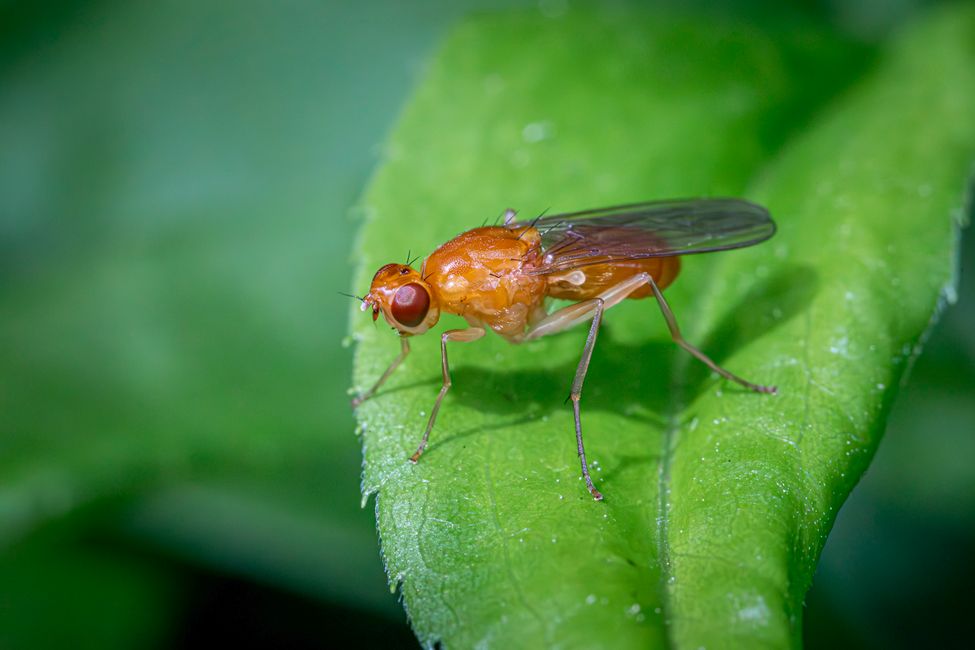
Scientists have completed something remarkable: a full map of every neural connection in an adult fruit fly's brain and nervous system. It's the most detailed picture we've ever had of how a complete nervous system is wired, and what it reveals challenges some of our assumptions about how brains create behaviour.
The research, published as a new connectome, charts the pathways between neurons throughout the fruit fly's central nervous system. Think of it as a complete wiring diagram, showing not just the brain but how it connects to the rest of the body. No one has mapped an adult animal's neural system at this level of detail before.
What the map revealed
The findings point to something unexpected. Rather than a single command centre orchestrating everything the fly does, complex behaviours seem to emerge from many smaller, distributed circuits working locally. Each region handles its own processing, and together they create the sophisticated movements and responses we see in the living animal.
This matters because we often think of brains as having a control room, a place where decisions get made and orders get sent out. This connectome suggests intelligence and coordination can arise in a more decentralised way. Local networks talk to each other, and behaviour emerges from their conversations.
*Photo: Google DeepMind · Pexels*
The fruit fly, despite its tiny size, is capable of remarkably complex things. It navigates three-dimensional space, responds to threats, finds food, and interacts with other flies. All of that happens through roughly 140,000 neurons. For comparison, a human brain has around 86 billion neurons, but the principles of how they connect and communicate may share common ground.
Why map a fly's brain
Fruit flies have been central to neuroscience research for decades. Their nervous systems are complex enough to be interesting but simple enough to study in detail. Mapping every connection gives researchers a foundation to understand how neural circuits produce movement, perception, learning, and memory.
The connectome also offers clues about how brains are organised more broadly. If distributed local processing is a fundamental principle in the fly, it might also apply to other animals, including us. That could shift how we think about everything from how we learn new skills to how our brains recover from injury.
*Photo: Roxanne Minnish · Pexels*
Understanding the architecture of a nervous system also opens doors to new questions. Researchers can now trace exactly which neurons connect to which, and start to test how information flows during specific behaviours. It's a bit like finally having the blueprint for a building you've been trying to understand from the outside.
What it means for us
This research sits at the intersection of biology, technology, and our understanding of the mind. While it's a study of fruit flies, the implications reach further. How does complexity arise from simple rules? How do brains coordinate action without a single conductor? These are questions that touch on resilience, adaptation, and the nature of intelligence itself.
For those of us interested in mental wellness, there's something quietly hopeful here. Brains are not rigid hierarchies. They are networks, flexible and distributed, where many small systems work together to create the whole. That distributed nature might be part of why brains can adapt, rewire, and recover. It's a reminder that our minds are more resilient and collaborative than we sometimes give them credit for.
The connectome also underscores how much we still have to learn. Mapping the connections is one thing; understanding how they work together in real time is another. But every step forward in neuroscience brings us closer to understanding ourselves, how we think, how we feel, and how we heal.
This research won't change your day tomorrow, but it adds another piece to the larger puzzle of how living systems create experience. And in a world that often feels overwhelming, there's something grounding about science that takes the time to map every connection, to see the whole picture, and to share what it finds.
The work reminds us that intelligence, behaviour, and even consciousness are not magic. They are the product of countless small interactions, wired together in ways we are only beginning to understand.
Based on reporting from sciencedaily.com.
Comments
Loading comments…