How Chimpanzee Calls Shed Light on the Mystery of Human Language
New research into wild chimpanzee communication reveals surprising parallels with how we build meaning through language.
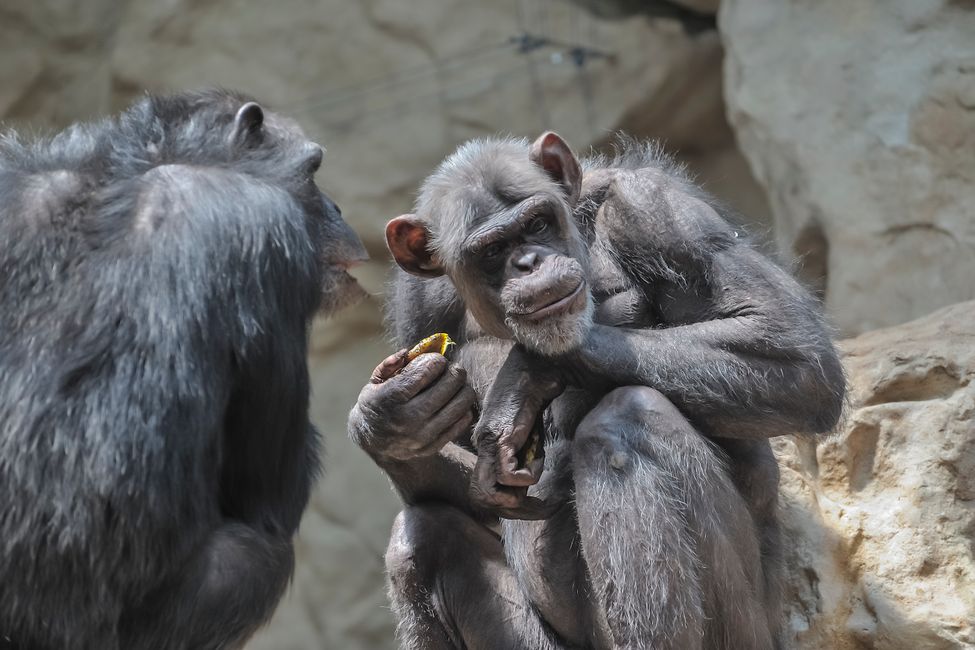
We like to think of language as uniquely human, the invisible architecture that lets us share complex ideas, tell stories, and connect across time and space. But new research into how wild chimpanzees combine their calls is revealing that the roots of language might reach further back than we imagined.
Scientists have discovered that chimpanzees in the wild don't just make isolated sounds. They alter the meaning of individual calls by embedding them into different combinations, a process that mirrors some of the fundamental operations we use in human language. It's a finding that opens a fresh window into one of evolution's deepest puzzles: how did we develop the capacity to create infinite meaning from a finite set of sounds?
The building blocks of meaning
Human language operates on a remarkable principle. We take a small collection of phonemes, the basic sound units, and combine them into thousands of words. Then we combine those words into an endless variety of sentences, each carrying its own precise meaning. This recursive quality, this ability to nest meaning within meaning, is what allows a child to invent a sentence never spoken before and still be understood.
What makes this new chimpanzee research compelling is that it shows our closest living relatives doing something structurally similar, if far simpler. They're taking individual calls and changing their meaning by placing them in different sequences. It's not language as we know it, but it suggests that the cognitive foundations for combining units of sound into larger meaningful structures existed before humans branched off on our own evolutionary path.

*Photo: İdil Ceren Çelikler · Pexels*
The challenge has always been one of scale. While humans can generate limitless combinations, animal communication has typically shown only a handful of meaningful pairings. A vervet monkey might have one alarm call for eagles and another for leopards, but it doesn't build those calls into elaborate warnings about an eagle that was seen yesterday near the waterhole. That gap between animal communication and human language has seemed unbridgeable, a mystery that leaves us wondering what changed, and when.
What the gap still tells us
Even with this discovery, the distance between chimpanzee call combinations and human language remains vast. The chimpanzees are working with a limited palette, creating meaning within narrow boundaries. We're working with a system that lets us discuss things that don't exist, imagine futures that haven't happened, and describe the inner landscape of our thoughts and feelings.
This difference matters deeply when we think about human connection. Language isn't just a tool for survival or coordination. It's how we reach across the gulf of individual experience. It's how a podcast can make someone feel less alone at three in the morning, how a friend's words can reframe a painful memory, how a therapist can help someone name what they've been carrying in silence.
The research doesn't solve the mystery of how we got from call combinations to Shakespeare, but it does suggest that the journey wasn't a single leap. There were steps along the way, structures building on structures, each generation of our ancestors adding complexity to what came before.

*Photo: Anna Shvets · Pexels*
Why this matters for human wellbeing
Understanding where language comes from helps us appreciate what it does for us now. Every conversation we have, every story we tell, every moment we put feelings into words is part of an evolutionary inheritance millions of years in the making. That's humbling and extraordinary at once.
For those of us interested in mental wellness, language is the primary tool we have for processing experience and connecting with others. When we feel isolated or overwhelmed, it's often because we're struggling to find the words, or because we haven't yet shared them with someone who can hear. The chimpanzees combining calls in the forest are doing something ancient, but we've taken that capacity and turned it into poetry, therapy, friendship, and understanding.
The mystery of how exactly that transformation happened remains unsolved. But knowing that the seeds were there long ago, in the call combinations of our distant cousins, reminds us that connection through communication is written deep in our nature. We're built to reach out, to make meaning together, to use the sounds we make to bridge the space between us.
Based on reporting from sciencedaily.com.



Comments
Loading comments…